Posts

Showing posts with the label academic writing

Minimalism and The Most Important

Image
Dear Real Academics, You may or may not have heard of The Minimalists  (but it's more likely you have at least heard about them since they currently have an audience of 20 million viewers!). Joshua and Ryan's story has, for several years, intrigued me. Despite having high paying jobs and lots and lots of material things, they both craved meaning and a sense of freedom from the weight of work stress and material things to manage. So, they made radical life changes leading to becoming The Minimalists. You can read more about them in the link above (but first, finish reading below- ha!). What I most like about Joshua and Ryan's version of the minimalistic philosophy is that it focuses, not just on having less  stuff, but on making room for more of what is important.  The question then becomes, what is most important? I don't claim to be a philosopher, but this is a critical life question. Once you answer this question, you then need to ask yourself, "What do I need...

Giving and Receiving Useful Feedback

Image
Dear Real Academics, Learning how to ask for and provide useful feedback revolutionized my writing and my teaching of writing. But, first, let me explain what useful feedback is not. What Useful Feedback is Not: An Illustration I was an English major for half of my college student life. In fact, my first Ph.D. program was in English Literature though I promptly realized it was not practical enough for me so I left with an M.A. I tell you this biographical information because I was steeped in the world of writing for a very long time; and, yet, I knew little about useful feedback or how to provide it to others. My college writing process looked something like the following: I would be given a writing prompt with a deadline. After I turned in my work at the end of the term, I would receive a letter grade at the top of my paper with a ton of comments on the sides in red ink. Consequently, when it was my turn to provide grades to large sections of undergraduate introduction to literature ...

End-of-Year Check

Image
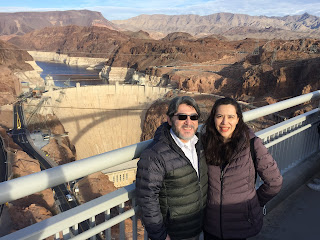
Dear Real Academics, We are back! We hope all of you have found some amount of time to rest and reflect and find peace during this time of year. Thank you for your continued readership support. And welcome to the newcomers this year! Your continued support and sharing of this resource with others is so important, and we thank you. This week I am sharing a picture of Dr. Garza and myself at the Hoover Dam. The Hoover Dam lies between Nevada and Arizona and was built during the Great Depression (i.e., the 1930's) in the United States. If you are ever in Las Vegas, we highly recommend you take the official "Dam Tour" and learn more about it. (And, yes, the tour guides will endlessly play on the word "dam" throughout the tour...dam tour, dam tourists, dam t-shirts...you get the idea).  The dam may not look as big as modern dams in other parts of the world, but for the time it was built and in the way in which it was built, the Hoover Dam is simultaneously a business...

Reviving a Sense of Wonder

Image
Dear Real Academics, Tiberio and I have a 2-year old "puppy" named Rocky. In this week's picture, Rocky is experiencing his first-time-ever small-town Christmas parade. Rocky had never seen a horse or a goat or a marching band or floats decked out with lights. So, when I saw him sitting so attentively and curiously looking at the parade, I had a sudden sense of awe myself thinking of what it must be like to experience something for the very first time.  As a writer, there is a part of me that needs and longs for awe and wonder. I find that I can revive that sense when I slow down, and I'd like to share some thoughts as to why this may be. In doing so, my goal is to help you (and me) with inspiration for writing and work. Slowing down can inspire my sense of awe and wonder by: (1) Allowing me time to be grateful. When I slow down, I can more easily appreciate what is in front of me instead of thinking about what I need to do next or ruminating on the past (which, unfor...

Taking a Break and Confession

Image
Dear Real Academics, I hope you had a nice Thanksgiving Break and found time to reflect on what you are thankful for, no matter how big or small. It is amazing what stopping to be thankful does to the soul! Confession The week before the break, I will confess that I was not heeding my usual advice about taking breaks between writing sessions. I had SO much on my plate, but I seemed to add more by constantly checking my emails, online courses, electronic calendar, and texts. At one point, my eyes literally started to hurt. And things got a bit blurry. My eye muscles were tired. I don't want this to happen to you (or to me!) as we close out the academic year. Challenge My challenge for you and for me is to make sure to take breaks at least every hour. By breaks, I mean literally setting a timer to remind yourself to GET OFF SCREENS for at least 5 minutes before your next writing/screen session. Allow your eyes to blink and your body to move and don't use the break to be on more s...

Writing and Perseverance - End of the Semester

Image
Dear Real Academics, I am not a marathon runner, but I know enough about endurance running to compare this time of the academic year to the near end of a race: seeing the finish line in the distance but being near exhaustion.  I've heard endurance athletes explain how 80% of finishing a race is mental/psychological.  This is how and why athletes in their middle age and beyond can and do often beat athletes in their twenties.  In other words, age is an advantage in the mental/psychological arena simply because of maturity and experience, and this psychological advantage trumps age and even natural physiology. As I think about myself as a writer, I can agree how age has certainly helped me psychologically endure more than I used to be able to endure.  I am able to handle rejection much better than before and any ego about my perfectionist tendencies that I can never quite achieve is out the window.  With that said, these facts do not mean perseverance gets any eas...

Writing Feedback and Gratitude

Image
  Dear Real Academics, November is traditionally the month of giving thanks in the United States. Ever since my family moved here from Mexico, Thanksgiving has been one of my favorite holidays, and one that I love to share with friends I meet who come from around the world. It is a time for counting and sharing the many blessings in my life. For all the bad in the world -- and there's an insane amount of bad at the time I am writing this blog post -- it is good for the soul to give thanks for blessings, no matter how big or small. This weekend, I provided writing feedback to about a dozen students in a small amount of time. These are students I have never met and that I do not teach. Some sent me whole dissertations. Some sent me small reflection paper assignments. Some sent me statistics assignments requiring a write-up. I thoroughly enjoyed providing them all feedback, but I'll be honest -- I was exhausted by the end of the weekend. (Hence, while this blog post is later than ...

Do You Want to Improve the QUALITY of Your Writing? The Relationship Between Distance and Quality

Image
Dear Real Academics, The month of October 2021 we gave our website a facelift. We had launched our website just 6 months before this date, but we realized it was already time to revamp it. Allowing our website to sit for some time and then revisiting it was a helpful exercise. Time "away" (i.e., distance) provided us with perspective to allow for quality revision.  Allow us to give you an application of the above story related to your writing. Writing Quality Tips If you want to improve the quality of your writing: Start as early as possible. Starting your writing project early gives you time to receive feedback from others and to provide you with personal distance (see points below). Seek feedback during different phases of your writing project (e.g., beginning, middle, end). External feedback provides a clear set of eyes to see your work and give you valuable reader-based feedback.  Allow personal distance from your project. Here, personal distance = putting a project...

Conflict and Writing

Image
Dear Real Academics, I've been thinking a lot about conflict lately. I've been thinking about it because I don't like it.   As much as I prefer harmony and unity, however, I need to be very careful about what this harmony and unity looks like. If what seem like harmony and unity comes at the expense of sacrificing freedom, then it is deceptive. Let me give you an example.  In academic discourse, which includes writing and speaking, something always "smells fishy" to me when I can anticipate what someone is about to say so that it aligns with popular lingo and assumed ways of thinking. I call this group think. Furthermore, when those who question or pose a different point of view are silenced or censored and/or held in contempt, then critical thinking is being suppressed in the name of a deceptive idea of unity. I don't know about you, but when I was learning to write persuasively, the idea was to have a well formed argument supported by carefully researched i...

Beauty and Writing

Image
Dear Real Academics, I like to write. However, when I was in graduate school, I started to dislike writing...a lot. Is this you? Or perhaps you already really dislike writing? Here I want to share one tip I learned from being in the P.O.W.E.R. writing services that helped rekindle my love for writing and which, I believe, can help anyone become a more motivated and perhaps even better writer. That one tip is to read something beautiful. That's right. If you are an academic writer, chances are that you are immersed in reading technical genres of writing. To be frank, most academic writing is, unfortunately, not beautifully written.  As a human, I believe a little bit of my soul starts to die if I am not exposed to beautiful things after long-periods of time. Perhaps that's why it's so important for me to remember to take a walk and look at the sky or to appreciate art and music and to read beautiful things.  Beauty does something good to my soul.   For a writer -- ...

Bats, Babies, and Bicycles

Image
 Dear Real Academics, What do bats, babies, and bicycles have in common? Apart from starting with the letter "b", my husband, puppy, and I ran into all of them on our walk/hike this weekend on the historic Railroad Pass in Boulder City, Nevada.  The Railroad Pass is a walking/hiking path that runs alongside the mountains adjacent to Lake Mead and leads to the Hoover Dam. The pass goes through a series of tunnels blasted into the mountains back in the 1930's when the Hoover Dam was being constructed (known as the Boulder Dam back then).  Railroad tracks were laid down to transport materials from Boulder City to the dam construction area. Today, the tracks have been covered and people like to walk (their dogs), push strollers with babies, jog, and ride their bikes along the trail and enjoy the beautiful views of the lake.  Here is a picture of us on the trail this weekend. If you look closely, you can see one of the mountain tunnels in the background where, of course, ...

Writing to Think

Image
Dear Real Academics, I have built much of my career off of the relationship between writing and thinking . The whole foundation of my research is based on the argument regarding the importance of utilizing language -- specifically writing -- to understand scientific concepts.  Writing can help us refine our thinking, and even change it. Writing can help us understand the world. Writing can help us understand ourselves.  The image of the solitary writer sorting through their thinking is not a myth. This image may be criticized, mainly from the angle of assuring writers they are not alone and that others are writing alongside them, and even with them. There is power to these points, and I greatly value my community of writers and am motivated by being part of writing groups.  But here, my point is that individuals -- whether writing alongside or with someone -- are still individuals with thoughts, emotions, feelings, hopes, and dreams unique to them. Writing is a form of di...

Writing Models

Image
Dear Real Academics, Did you know there's such a thing as a writing model? And, here, I don't mean a person holding up the palm of their hand under a piece of paper to display it. Here I mean an example of writing similar to the one you need to or want to (or both!) compose. When I was in graduate school, I knew I needed to write a dissertation in order to graduate. Early in my program, I had never written a dissertation, much less read one. So, I looked for dissertation models in my program and studied them -- not for the content but for the structure. I asked myself: How long are dissertations? (they vary tremendously depending on methodology, I discovered!). How are dissertations organized? (there are traditional chapters, but there are formats that include a collection of related journal articles). How does each dissertation section begin and end? (I learned they are fairly repetitive in the beginning and end of each section because they are so long and want to remind the ...

How to be a Happy and Productive Writer

Image
Dear Real Academics, Happy writers can be productive writers. Happy productive writers are aware of two important things: (1) Their time. (2) Their creative process. [Note: I provide a ton of resources in this post just because I was so excited to make all these connections and share them with you! Be sure to check out any that look useful to you]. BACKGROUND I recently watched a fascinating video interview with Dr. Ken Atchity -- author, professor, screenwriter, producer, literary manager -- which affirmed and solidified the above two points for me. His book, A Writer's Time: Making the Time to Write , is on my short list for reading now: (paid link) Ken mentions two types of productive people: the unhappy ones and the happy ones. The unhappy productive person can be the typical Type A workaholic and/or the stereotypical depressed creative. The happy productive people, according to Ken, -- get this -- are AWARE of their creative process and know how to manage it. I could ...

Need a Boost of Encouragement? The Accomplishment List

Image
Dear Real Academics, As faculty (at the time of this writing), I am on a 9 month-contract.  But, every summer for the past 7 years in my tenure-track position seems to be a non-stop list of things to do including attending dissertation defenses, reviewing manuscripts, reviewing conference proposals, going to research meetings, analyzing data, writing and submitting conference proposals, writing and submitting manuscripts and grants, setting up classes for the next semester, setting up meetings for the next semester,  answering student advising emails,  managing upcoming faculty searches, and more. So, you can imagine how annoyed I get when I hear people assume that I am so lucky to be an "educator" because I get summers off. I wish!  Around the end of July this year, I was near burn-out.  Around the first week of August , I was looking ahead to the gazillion of emails streaming into my in-box to get things set up for the start of the semester (not to mention the...

I'm Overwhelmed! How to Eat an Elephant and Other Ideas

Image
Dear Real Academics, At certain times of the year -- particularly the beginning, middle, and end of semesters -- I start feeling anxious about all the large and many small projects ahead of me. Large things could be dissertations, manuscripts, grants, large assignments to grade... Smaller things could be a seemingly endless "to do" list such as scheduling meetings, attending meetings, answering emails, setting up classes for the next term, and/or learning new systems.  If you are not an academic by profession, you may still relate to some of the above types of tasks. Everyone may also have long-term goals related to health (e.g., eating healthier), finances (e.g., getting out of debt), or other (e.g., figuring out life changes).  Whatever your large project and/or many tasks, one way to NOT feel overwhelmed is to break things down into small steps.  This is by no means a new idea. Perhaps you've heard the staying, "A journey of a thousand miles begins with a single s...

Producing Meaningful Work

Image
Dear Real Academics, In my line of work quantity and quality are important.  As a professor, I am expected to publish a lot and publish with quality. I won't go into what "a lot" or "quality" means here. Regardless, there is an expectation for both categories. I suspect in most lines of work quantity and quality are important.  For example, the neighborhood I currently live in is under major development. Started in 2007, this community is expected to be a 15 year project with up to 15,000 new homes developed, though I suspect they'll go longer given the 2008 economic crash and the current pandemic.  At this moment, some of you know the housing market is insane in terms of demand. In the evenings, when my husband and I walk our dog, we see the quickness of house foundations and pipes being laid, house frames which seem to appear from one day to the next, and finishing touches (roofs, walls, etc.) that seem slapped on overnight. Despite this quickness, the hou...

The Power of Logging

Image
Dear Real Academics, There's a pattern among productivity strategists: If you want results, track your progress. Whether I'm watching a video or reading about financial planning, nutritional well-being, exercise programs, writing productivity, or self management in general, all programs that WORK have some element of what I default to calling "logging". I default to this term because of my experience with logging with writing (more on that below). Logging is tracking your progress.  I know, I know...it sounds dull and mundane and boring and hard to remember to do. It may even sound rigid, but here's the news: It is powerful. Why? This is a good question. For this post, I will not get into any facts or figures or empirical data to prove to you that tracking your progress is powerful when it comes to making progress.  But, reflect on your own experience. When have you made real progress on any goal you had that required change/effort/difficulty? What did it look lik...

I Don't Know What to Write!

Image
Dear Real Academics, There's an old Frasier episode where two of the main characters -- who, by the way, have Ph.D.'s -- are trying to co-write a book manuscript. For those of you who don't know, Frasier is a sitcom from the 1990's. 😊 They try to write at home, but they draw a blank on how to begin the first sentence.  So, they decide to lock themselves in a hotel to be free of distractions.  As one poses his fingers over the keyboard, the other finally comes up with one sentence, while the other elaborates on it.  But it's too late.  The sun comes up and they managed to only write one sentence by their due date. Of course, this is what I want to NOT happen to you.  But... Have you ever felt this way?  Perhaps you have so much you want to say but you don't know where to start. Or, like the sitcom characters described above, you are afraid of getting that first sentence perfect. Perhaps you just don't know what to say. Or,  you are afraid that if you s...